
Few songs from the 1980s have demonstrated the kind of sustained cultural staying power that “Every Breath You Take” by The Police continues to command decades after its release.
Written by Sting and featured on the band’s fifth and final studio album, Synchronicity, the track arrived in 1983 and immediately rewrote the commercial landscape of that year’s pop and rock charts.
A recent short-form video celebrating the song has drawn nearly 150,000 views, with comments pouring in from listeners across Italy, France, Spain, and beyond — a testament to how thoroughly the song transcends its era and its language of origin.

The Police recorded “Every Breath You Take” during sessions that would define the peak of their creative output. Sting contributed lead and harmony vocals alongside bass guitar, piano, synthesizers, and double bass, while guitarist Andy Summers delivered the song’s instantly recognizable, arpeggiated guitar figure — one of the most replicated chord progressions in modern rock history.
Drummer Stewart Copeland provided the restrained, metronomic rhythm that gives the song its taut, watchful tension. The production, helmed by Hugh Padgham and Sting himself, favored clarity and space over the dense arrangements common in early-eighties pop, which allowed each instrument to register with unusual precision and emotional weight.
On the charts, the song’s performance was extraordinary. It held the top position on the Billboard Hot 100 for eight consecutive weeks and spent four weeks at number one on the UK Singles Chart, making it one of the dominant commercial forces of its release year.

At the 1984 Grammy Awards, the Recording Academy honored it with two prizes — Song of the Year, awarded to Sting as its writer, and Best Pop Performance by a Duo or Group with Vocal, awarded to The Police as a band.
Rolling Stone magazine has since placed it at number 84 on its list of the 500 Greatest Songs of All Time, cementing its position not merely as a h.i.t but as a work of lasting artistic significance.
Part of what gives the song its enduring grip on audiences is a quality that Sting himself has acknowledged publicly — the lyric, though set to a melody of considerable warmth and beauty, describes something far more unsettling than a conventional love song.
The narrator’s obsessive surveillance of another person lends the track an undercurrent of psychological unease that listeners have interpreted in widely different ways across the decades.
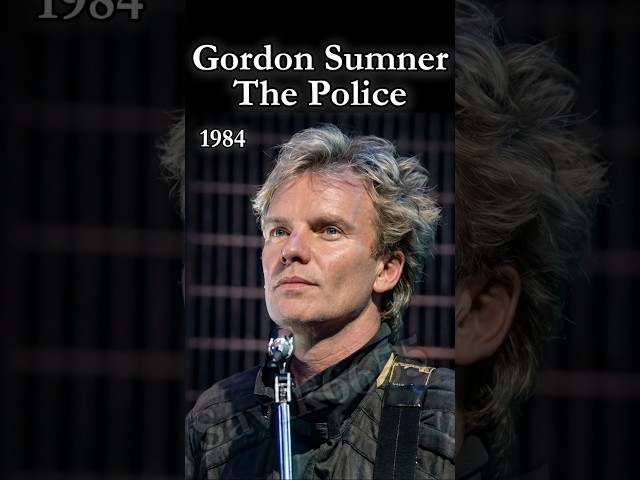
That ambiguity has made it adaptable: it has been sampled extensively, covered across genres, and licensed to films, television series, and advertising campaigns in numbers that few rock compositions can match.
The audience comments attached to this particular video reflect that universality — viewers write in Italian, Spanish, and French, their enthusiasm cutting across any language barrier.
The full performance, set to the band’s original recording in a special short-form video mix, is available to watch below. For anyone returning to the song after years away, or discovering it for the first time, it remains as precisely crafted and as quietly compelling as it was when it first reached listeners more than four decades ago.